Per-Seat vs. Usage-Based vs. Hybrid Pricing: Which Fits an Early-Stage SaaS in 2027?
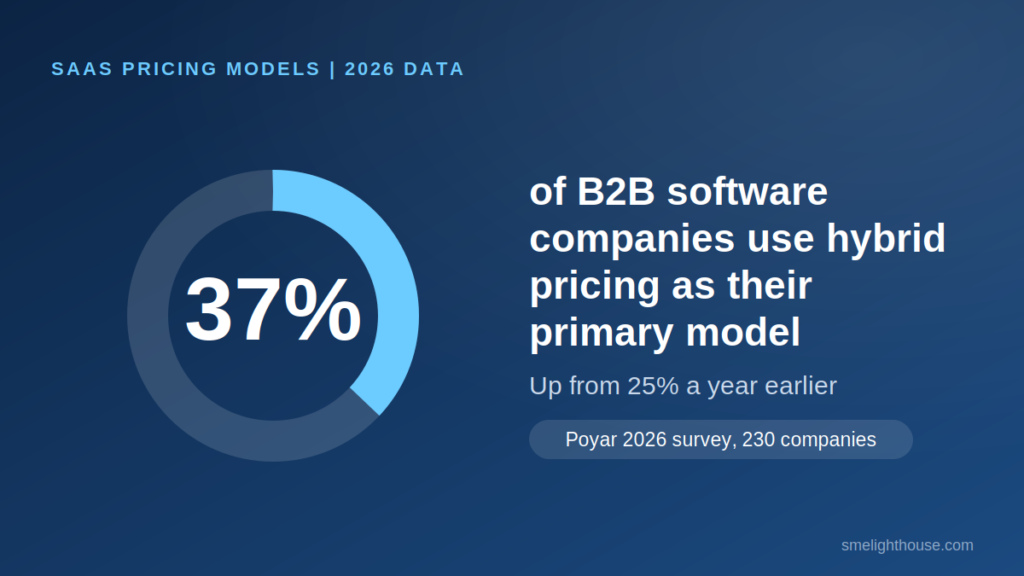
Hybrid pricing is gaining ground among B2B software companies. In Kyle Poyar’s 2026 survey, 37% of respondents identified hybrid as their primary pricing model, up from 25% a year earlier. His 2025 survey also found that seat-based pricing had fallen from 21% to 15%. Meanwhile, Gartner forecasts that at least 40% of enterprise SaaS spending will move towards usage-, agent- or outcome-based pricing by 2030, according to Deloitte.
While these figures help inform forecasts of SaaS pricing models 2027, they largely reflect established businesses with existing customers, usage data, and operating costs to analyse.
For early-stage SaaS founders with less information, the key question is which unit to charge for, how it relates to customer value, and how to test the price before committing to development.
What Do the 2025-2026 SaaS Pricing Statistics Tell Us?
The 2025 and 2026 research points towards greater adoption of hybrid pricing; however, the figures need context.
| Finding | Reported Figure | Source |
| Hybrid pricing | 37% of 2026 respondents, compared with 25% a year earlier | Poyar, State of B2B Monetization 2026 |
| Variable or hybrid pricing among AI-native companies | 76%, compared with 49% among SaaS companies | Poyar’s October 2026 analysis |
| Flat-fee pricing among companies under $5M ARR | 37%, the most common model in that group | Poyar, 2026 |
| Per-seat pricing among companies over $150M ARR | 29% still rely on legacy seat-based pricing | Poyar, 2026 |
| Enterprise SaaS spending by 2030 | At least 40% forecast to move towards usage-, agent- or outcome-based pricing | Deloitte’s 2026 technology predictions |
| Gross margins for AI products | 50% to 60%, compared with 80% to 90% for traditional SaaS | Bessemer Venture Partners’ AI pricing playbook |
How should you interpret the 2025 and 2026 surveys?
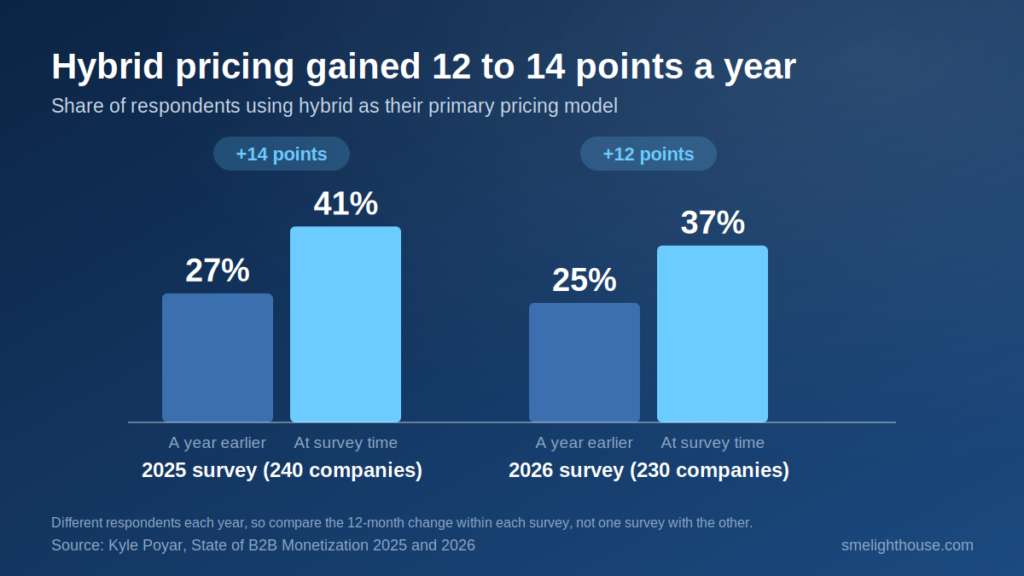
Poyar’s surveys involved different groups of respondents, so their headline figures should not be treated as one continuous trend line. The 2025 survey reported hybrid pricing increasing from 27% to 41% over the preceding year. In the 2026 survey, respondents reported an increase from 25% to 37%.
Both surveys indicate that hybrid pricing gained ground within their respective reporting periods. But they do not establish that every SaaS business should adopt it.
The early-stage figures are particularly relevant here. Flat-fee pricing remained the most common choice among companies under $5M ARR in Poyar’s 2026 survey. A simple starting price point makes sense when a company has limited usage history and needs to attract its first customers.
The decision for an early-stage founder is therefore not whether to follow the latest trend, but which pricing model fits the product, its costs, and how customers receive value.
What Is the AI Impact on SaaS Pricing Models Going Into 2027?
AI is putting pressure on seat-based pricing because one user can now direct software agents to complete work that previously required several people. At the same time, AI features can introduce variable compute costs that traditional SaaS products often do not incur at the same rate.
This creates two pricing challenges:
First, charging per user may understate the value of software that completes tasks independently. Second, charging a fixed fee without accounting for usage can expose the business to rising delivery costs.
However, AI does not make per-seat pricing obsolete. Poyar’s 2026 survey found hybrid pricing was the most common model, while a substantial share of large companies continued to rely on seats. Deloitte also expects the transition to new pricing approaches to take time.
For founders, the practical question is whether the product’s value and cost to serve increase with the number of users, the volume of work completed, or the results delivered. That relationship should guide the pricing decision.
Per-Seat vs Usage-Based Pricing: Which Fits an Early-Stage SaaS?
Per-seat pricing fits products whose value grows with the number of people using them. Usage-based pricing fits products whose value or delivery costs track consumption. Hybrid pricing can combine a predictable subscription with a variable charge.
For an early-stage SaaS, start with the simplest model that reflects customer value and covers the cost of serving customers. Add complexity when customer behaviour or cost data justifies it.
Types of SaaS pricing models compared
Per-seat, usage-based, outcome-based, and hybrid pricing describe different ways to calculate a customer’s bill. Flat-rate and tiered pricing describe how prices are packaged, and can be combined with these models.
| Model | What the customer pays for | Best suited to | Main risk | Notable SaaS examples |
| Per-seat | Each user or licence | Products where value grows with team size and additional users cost little to serve | Revenue may not reflect value when software completes work independently | Slack, Microsoft 365 Copilot |
| Usage-based | Consumption, such as API calls, tokens or tasks | Products where consumption tracks value or delivery costs | Customers may struggle to predict their bills | Snowflake, Twilio |
| Outcome-based | A defined result, such as a resolved support ticket | Products with measurable, attributable, and consistent outcomes | Disputes can arise when results vary or attribution is unclear | Intercom Fin AI Agent, Zendesk AI agents |
| Hybrid | A base subscription plus usage or outcome charges | Products that need predictable recurring revenue while accounting for variable usage or costs | Pricing can become difficult to explain if the components are too complex | Vercel, Intercom |
What are the trade-offs between per-seat and usage-based pricing?
Per-seat pricing gives customers a relatively predictable bill and gives the business a recurring revenue base tied to the number of users. It is straightforward when the product supports people’s work and each additional user costs little to serve.
Usage-based pricing can align charges more closely with consumption and variable delivery costs. It also allows revenue to grow as customers use more of the product. However, customers need a reasonable way to estimate and control their spending, while the business must account for fluctuations in revenue.
Hybrid pricing balances those needs by combining a base subscription with usage charges. Its main drawback is complexity: customers need to understand what the base fee covers, what triggers additional charges, and how much their total bill could reach.
The right choice depends on how customers experience value, what it costs to deliver that value, and how predictable their spending needs to be.
Does Per-Seat Pricing Still Work for B2B SaaS Without AI?
Yes. Per-seat pricing remains a sound option when customer value grows with the number of users and serving an additional user costs relatively little.
For example, a project management platform may become more valuable as more employees join the workspace. Charging per seat reflects that expansion and gives the customer a bill they can estimate from headcount.
A product that automates tasks presents a different case. If one user can run hundreds of tasks through the software, the number of seats may no longer reflect the value delivered or the cost of providing the service.
AI features also do not automatically require a new pricing model. A company may keep a per-seat subscription if it can cover the additional compute costs within its margins. If usage varies substantially, a usage allowance or additional consumption charge may be more appropriate.
The decision should follow the economics of the product rather than the presence or absence of AI.
B2B SaaS Pricing Models 2027: A Three-Question Test
Answer these three questions to narrow down the pricing models worth testing.
1. Who does the work?
If people perform the work and your product helps them, seats may track value well. If the software completes tasks independently, consider charging for consumption, outputs, or measurable results.
2. Does your cost to serve rise with usage?
If costs remain relatively stable as customers use the product more, a fixed or per-seat fee may work. If compute or other delivery costs rise with usage, consider a usage component to protect margins.
3. Can you measure the result consistently?
Outcome-based pricing requires a result that can be measured and attributed to your product. Poyar’s CAMP framework assesses whether outcomes are consistent, attributable, measurable, and predictable. If you cannot establish these conditions, start with a simpler pricing model.
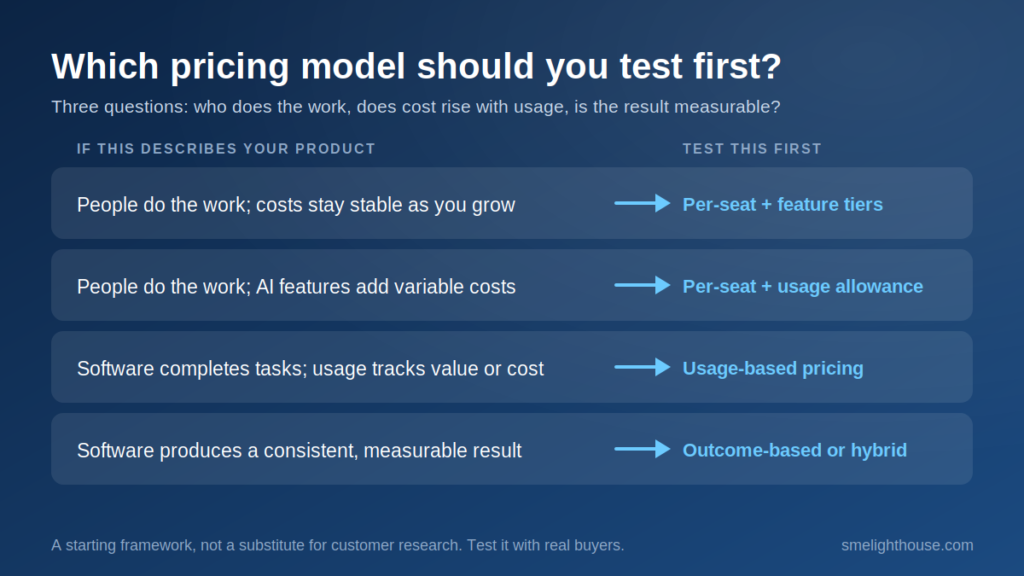
Based on your answers, your starting point might be:
| Product characteristics | Model worth testing first |
| People do the work; costs remain stable as the team grows | Per-seat, potentially with feature tiers |
| People do the work; AI features introduce variable costs | Per-seat subscription with a usage allowance |
| Software completes tasks and usage tracks value or cost | Usage-based pricing |
| Software produces a consistent, measurable result | Outcome-based pricing or a hybrid |
This is a starting framework, not a substitute for customer research. Test whether buyers understand the pricing, can estimate their bills, and see a clear relationship between the price and the value they receive.
What Will SaaS Pricing Look Like in 2027?
The available 2025 and 2026 evidence supports an expectation of more hybrid and variable pricing, particularly for AI products. It does not establish that seat-based pricing will disappear or that one model will dominate every market.
| Likely development | Evidence | Confidence |
| Hybrid pricing remains prominent | Hybrid led both Poyar surveys and gained ground within each reporting period | High that it remains an important model |
| AI products adopt more variable pricing | 76% of AI-native companies used variable or hybrid pricing, compared with 49% of SaaS companies, in Poyar’s 2026 data | High for AI-native products; less certain across SaaS |
| Per-seat pricing continues | 29% of companies over $150M ARR still used legacy seat-based pricing, and Deloitte describes seats as the general norm today | High that seats remain in use |
| Outcome-based pricing receives more attention | Poyar’s 2025 survey reported that 5% used it as their primary model while 25% expected to by 2028 | Direction is plausible; however, the scale remains uncertain |
| Companies review pricing more often | Three in four respondents reported changing pricing or packaging in the preceding year | High that pricing reviews remain common |
Note: These are editorial expectations based on past and current evidence, not a forecast for every pricing model.
For an early-stage founder, choose a pricing unit that can grow with customer value, keep the initial offer easy to understand, and review the model once you have evidence from paying customers. Avoid building a complicated pricing system around usage patterns you have not observed yet.
How to Price a SaaS Product Before You Have Customers
You can test your pricing assumptions before development by identifying the value customers expect, estimating delivery costs, and asking potential buyers to make a real commitment.
1. Choose the unit that reflects the customer’s workflow
Map the customer’s current process and identify where time, money, or effort is lost. Then determine whether the value your product creates is tied to users, tasks, consumption, or results.
Our guide to defining MVP scope from the customer workflow explains how to identify the core workflow your first release should address.
2. Set a price based on value and check your costs
Estimate what the problem costs the customer today and what they could reasonably gain from solving it. Then check whether the proposed price can support the cost of delivering the product, including AI compute where relevant.
Bessemer’s AI pricing playbook discusses the tension between customer value, willingness to pay and the lower gross margins that can accompany AI products. Cost matters, but a cost-plus calculation alone does not establish what a customer will pay.
3. Test the price before you build
Present potential customers with a clear offer and ask for a meaningful commitment. Depending on your product and sales process, that could be a paid pilot, deposit, pre-order, or signed letter of intent.
Positive interview feedback can help you understand the problem, but a commitment at a stated price gives stronger evidence of willingness to buy. Our guide to validating a startup idea with pre-sales explains how to test demand before committing to development.
4. Test willingness to pay systematically
Test different price points with comparable prospects and record how they respond. If buyers accept immediately, that alone does not prove your price is too low; they may simply see strong value. If prospects hesitate, find out whether the issue is price, trust, timing, missing features, or the offer itself.
5. Keep the first version simple
Choose a pricing structure customers can understand and your team can administer. You can introduce usage tiers, add-ons, or outcome-based charges later if customer behaviour and cost data justify them.
Bootstrapped founders need to pay attention to early revenue because it supports continued operations. Our analysis of bootstrapped vs. VC-backed SaaS explores the different pressures founders face as they finance growth.
Choose a Pricing Model You Can Validate
Pricing is part of validating a SaaS idea. The unit you charge for, the price you set, and the willingness of customers to pay are all assumptions you can test before development.
Per-seat pricing can work when value grows with the number of users. Usage-based pricing can fit products whose consumption or delivery costs vary. Hybrid pricing can combine a predictable base fee with charges that reflect additional usage. The right choice depends on your product and the evidence you gather from potential customers.
If you’ve interviewed customers or tested a price but are unsure what the findings support, a problem-solution fit review can help you identify what you have validated and what still needs testing.
Book a free 30-minute discovery call with the SMELighthouse team to discuss your idea and the evidence you’ve collected.
Frequently Asked Questions About SaaS Pricing Models
What are the different types of SaaS pricing models?
Common approaches include flat-rate, tiered, per-seat, usage-based, outcome-based, and hybrid pricing. Per-seat pricing charges by user, usage-based pricing charges by consumption, and outcome-based pricing charges for a defined result. Hybrid pricing combines a base subscription with usage or outcome charges. Flat-rate and tiered pricing describe how plans are packaged and can be combined with other models.
What percentage of SaaS companies use hybrid pricing?
In Poyar’s 2026 survey, 37% of 230 B2B software companies identified hybrid as their primary pricing model, compared with 25% a year earlier. Figures from other surveys may differ because their samples and definitions are not identical.
What will SaaS pricing look like in 2027?
The available evidence points towards continued interest in hybrid and variable pricing, particularly among AI-native companies. Per-seat pricing is also likely to remain in use. These are expectations based on 2025 and 2026 research, not a definitive forecast for 2027.
What is replacing per-seat SaaS pricing?
Hybrid and usage-based approaches are gaining attention, especially for products whose value or delivery costs vary with consumption. However, per-seat pricing remains relevant where the number of users reflects value and costs remain predictable.
Is per-seat pricing dead?
No. Poyar’s 2026 survey found that 29% of companies with more than $150M ARR still relied on legacy per-seat pricing. The model can work when value grows with the number of users and the cost of serving each additional user remains low.
What’s the best pricing model for an early-stage SaaS?
There is no single best model. Start with the simplest approach that reflects customer value and covers delivery costs. Test the offer with potential buyers, then adjust the pricing model when customer behaviour or operating data provides a reason to do so.
How often should an early-stage SaaS change its pricing?
Review your pricing after acquiring your first customers and whenever your costs, product, target market or customer behaviour changes significantly. Regular reviews help you identify whether the price and charging structure still fit the business.
How do you price a SaaS product before launch?
Identify the value your product creates, choose a pricing unit that reflects that value, check delivery costs, and test the price with potential buyers. Commitments such as paid pilots, deposits, or pre-orders provide stronger evidence than positive feedback alone.

Onyekachukwu Blessing
http://linkedin.com/in/onyekachukwu-blessingOnyekachukwu Blessing is an SEO content strategist specializing in long-form content, editorial strategy, and organic growth. She creates research-driven content that helps businesses improve search visibility, build topical authority, and communicate complex ideas clearly. Her experience spans business, lifestyle, startups, wellness, SaaS, and digital publishing.