AI Took 64% of Venture Funding in Q3 2026. What Does It Mean for SaaS Founders?
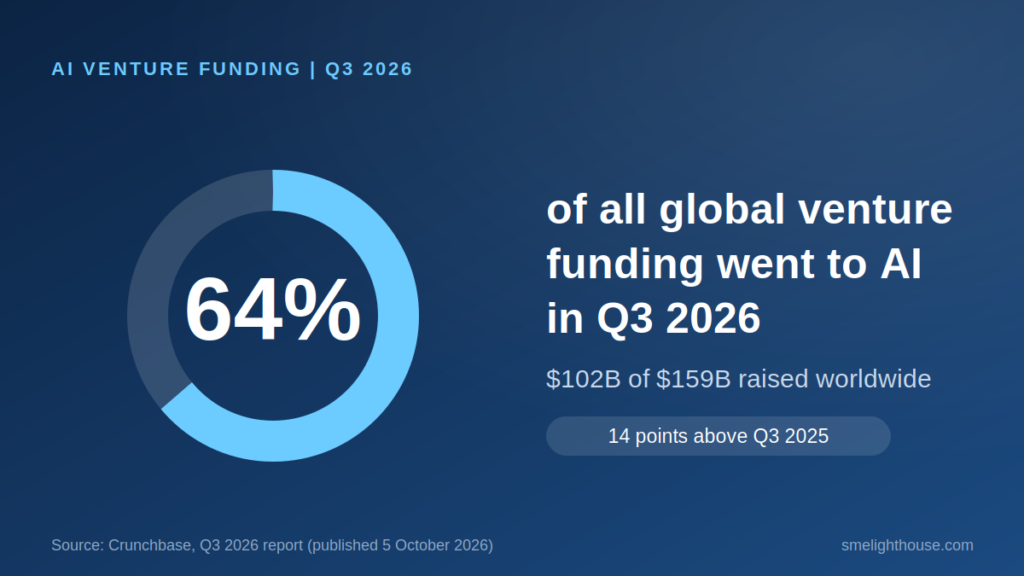
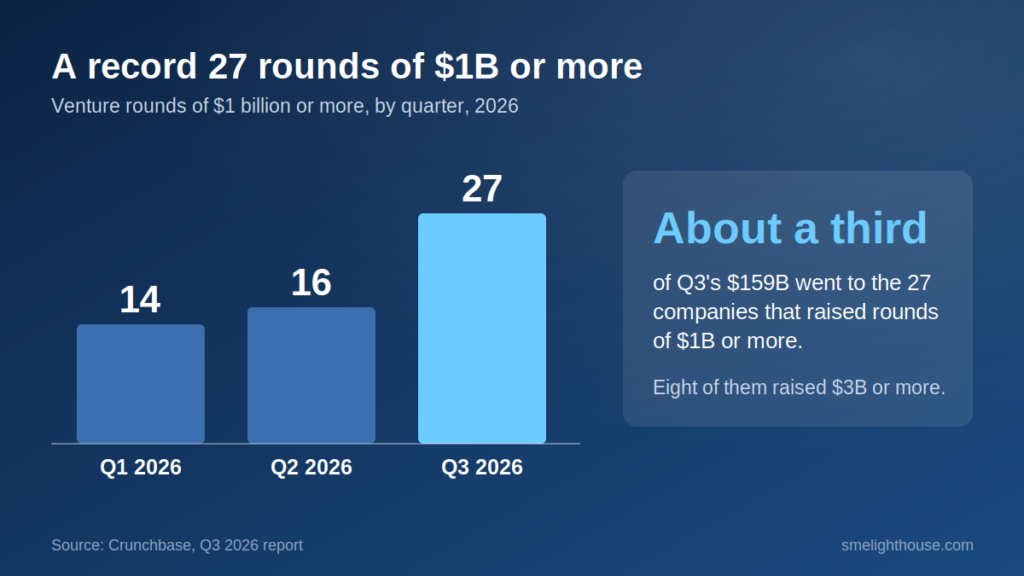
AI-driven startups raised $102 billion in Q3 2026, accounting for 64% of global venture capital, according to Crunchbase’s quarterly report published on 5 October. Global venture funding reached $159 billion, and 27 companies raised rounds of $1 billion or more, accounting for around a third of the quarter’s funding.
The year-to-date figures show how much money is in the market. Startups raised $679 billion from January through September, the highest total for the first three quarters of any year on record. That scale hides how unevenly the money is spread, so these headline figures tell only part of the story for SaaS founders seeking capital.
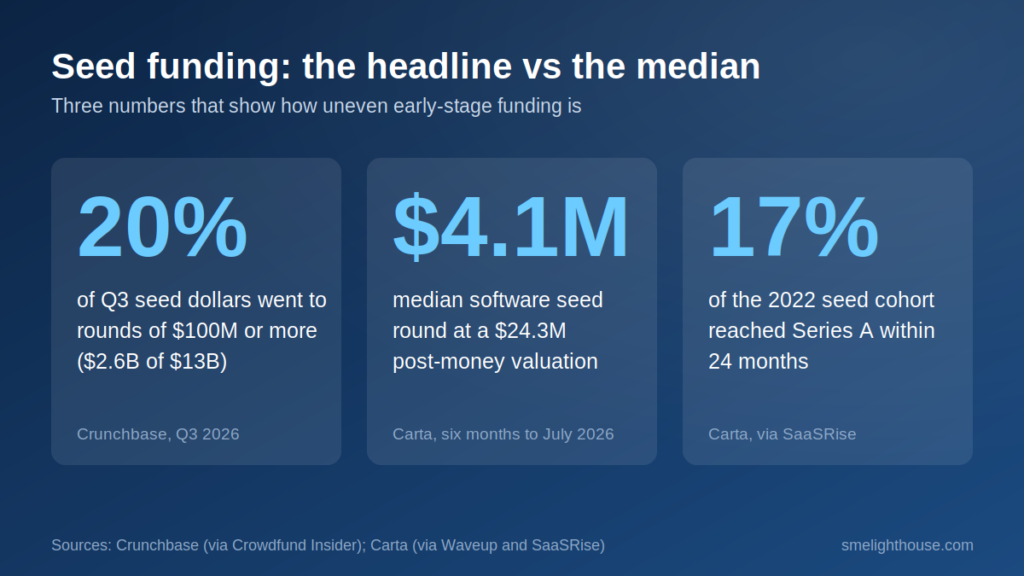
The median software seed round was $4.1 million, while just 17% of Carta’s 2022 seed cohort reached Series A within 24 months. Crunchbase’s Q3 report and Carta’s fundraising data measure different parts of the market, but together they reveal a clear gap between total capital raised and the funding available to a typical early-stage company.
So, what does this mean if you’re building a SaaS product outside the AI funding rush? There is still capital in the market, but the headline totals don’t tell you how much is accessible to your business, what investors expect at your stage, or whether your evidence of customer demand is strong enough to support a funding decision.
This AI venture funding report examines the latest AI venture funding statistics, explains the factors behind the quarterly figures, and looks at the implications for SaaS founders at different stages. It also addresses an important distinction: money in the market doesn’t prove that customers want what you’re building, and 43% of failed startups cite no market need as a reason.
Key AI Venture Funding Statistics (Q3 2026)
| Statistics | Latest Figure | Source |
| Global venture funding, Q3 2026 | $159B across nearly 6,000 startups | Crunchbase |
| AI share of venture funding | $102B, or 64% | Crunchbase |
| Change in global funding from Q2 | Down 25% from $212B | Crunchbase |
| Change in global funding year on year | Up 53% from $104B in Q3 2025 | Crunchbase |
| Billion-dollar funding rounds | 27 in Q3, compared with 16 in Q2 and 14 in Q1 | Crunchbase |
| Global funding in Q1–Q3 2026 | $679B, a record for the first three quarters of a year | Crunchbase |
| Early-stage funding in Q3 | $40.6B, up 25% year on year | Crowdfund Insider, citing Crunchbase |
| Seed funding in Q3 | $13B, of which $2.6B in rounds of $100M or more | Crowdfund Insider, citing Crunchbase |
| Median software seed round | $4.1M raised at a $24.3M post-money valuation; approximately 18% dilution | Carta (six months to July 2026) cited by Waveup |
| Seed companies reaching Series A | Approximately 17% of the 2022 cohort within 24 months | Carta, cited by SaaSRise |
| Median software Series A round | $14.4M raised at an $80M post-money valuation | Carta (six months to July 2026) cited by Waveup |
| Series A valuation: non-AI vs. AI foundation model | Approximately $55M vs. $300M | Carta cited by Causo |
Note: Funding rounds, valuations, and cohort progression measure different things and should not be treated as interchangeable benchmarks.
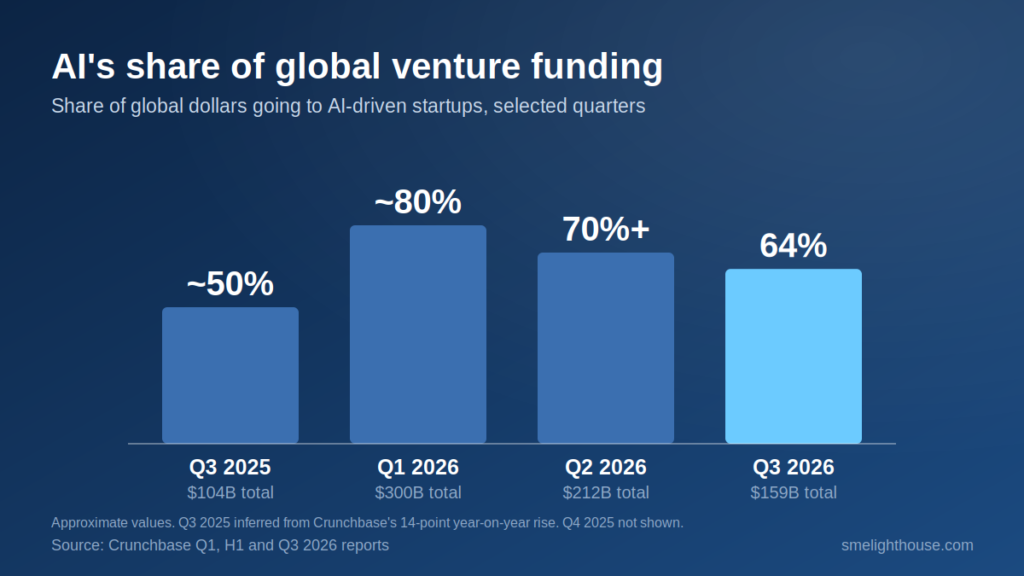
How AI’s Share of Venture Funding Has Moved in 2026
| Quarter | Global Venture Funding | AI Share |
| Q3 2025 | $104B | Approximately 50% |
| Q1 2026 | $300B | Approximately 80% |
| Q2 2026 | $212B | More than 70% |
| Q3 2026 | $159B | 64% |
Sources: Crunchbase’s Q1 report, H1 report and Q3 report. Q2 funding was initially reported at $205B and subsequently reflected as $212B in the Q3 comparison. The Q3 2025 AI share is approximately 50%, inferred from Crunchbase’s reported 14-point year-on-year increase.
Why Did AI’s Share of Venture Funding Fall to 64% While Mega-Rounds Hit a Record?
The AI venture funding trends in 2026 show how a small number of large rounds can influence quarterly totals.
AI’s share of global venture funding fell from approximately 80% in Q1 to 64% in Q3, even as the number of billion-dollar rounds reached a quarterly record. The main explanation is that the size and distribution of individual funding rounds can change the quarterly totals significantly.
In Q1, four AI financing rounds accounted for approximately $188 billion combined. OpenAI raised $122 billion, Anthropic raised $30 billion, xAI raised $20 billion, and Waymo raised $16 billion. Together, those rounds represented roughly 63% of the quarter’s $300 billion in global venture funding.
Q2 was also heavily influenced by one large deal. Anthropic raised $65 billion, accounting for close to a third of the quarter’s funding. Crunchbase initially reported $205 billion in global venture funding for Q2, later comparing Q3 against a revised figure of $212 billion.
By Q3, the largest individual rounds were considerably smaller. Databricks and Safe Superintelligence each raised $5 billion, while eight companies raised $3 billion or more. There were still 27 rounds of at least $1 billion, but no single company announced a round in the tens of billions.
That distinction matters because a record number of large rounds does not mean funding is evenly distributed across startups.
Where Is the Money Going Beyond AI Software?
The AI funding category also needs context. It covers more than AI applications and SaaS products and includes companies developing foundation models, infrastructure, and other technologies that support AI systems.
Meanwhile, sectors such as aerospace, robotics, data centres, semiconductors, and energy each attracted more than $10 billion in Q3, according to Crunchbase. Physical AI also recorded $47.4 billion across 521 deals in the first half of 2026, almost four times the $12 billion recorded in the second half of 2025.
These figures help explain why the funding market cannot be reduced to a competition between AI and non-AI SaaS. Capital is flowing into multiple industries, and even within AI, investors are backing businesses with very different capital requirements, business models, and routes to revenue.
Crunchbase also reported that around half of Q3 venture funding went to companies founded since 2022. That suggests investors are still willing to back young companies. However, the aggregate figure does not tell us how many of those companies are early-stage SaaS businesses, nor how much funding is available to a founder without a comparable profile or opportunity.
The practical conclusion is that the market remains active, but the headline total needs to be read alongside company stage, sector and round size.
What Does the Headline Funding Number Hide About Early-Stage Founders?
The early-stage figures give a more useful picture of the funding environment for founders building a new product. Crunchbase reported $40.6 billion in early-stage funding in Q3, up 25% year on year. Seed funding reached $13 billion.
Those totals sound encouraging until you look at where the money went. Approximately $2.6 billion of seed funding was concentrated in rounds of $100 million or more. That is around 20% of the seed total going to a small number of large deals.
The median software seed round provides a different benchmark. Carta’s data for the six months to July 2026 puts the median amount raised at $4.1 million, with a $24.3 million post-money valuation and approximately 18% dilution.
The contrast between a $100 million-plus seed round and a $4.1 million median illustrates how much variation is in the same funding category. A founder reading only the largest announcements could easily develop unrealistic expectations about the capital available for a typical seed-stage company.
How Many Seed Startups Reach Series A?
Carta estimates that approximately 17% of companies in its 2022 seed cohort reached Series A within 24 months. That figure is a measure of progression to the next funding stage within a defined period. It does not mean that the remaining 83% failed, shut down, or never raised another round.
Some companies may continue operating without venture capital. Others may raise later, generate revenue, or decide that a different growth model suits their business better. Still others may struggle to demonstrate the traction investors require.
The key point is that raising a seed round does not guarantee access to Series A. Founders need to demonstrate progress between funding stages, and what counts as sufficient progress depends on their business model, market, and investor expectations.
Imagine a founder planning to spend $50,000 to $150,000 testing a SaaS idea before committing to a full build. That budget is roughly 27 to 82 times smaller than the median software seed round of $4.1 million. The comparison is illustrative rather than a like-for-like funding benchmark: one figure is a proposed pre-build budget, while the other represents capital raised by companies that have already secured seed investment.
Even so, it highlights a useful decision. A founder does not need to imitate the spending of a venture-backed company to establish whether a problem is worth solving. The immediate objective is to gather enough credible evidence to decide what to build, what to test further, and what would justify a larger investment.
Can a Non-AI SaaS Startup Still Raise Venture Funding in 2026?
Yes. SaaS funding remains available to non-AI companies, although the headline figures don’t tell founders how much capital is accessible to their business or what investors expect at their stage.
Carta’s Q1 2026 figures, as reported by Causo, put the median Series A post-money valuation for non-AI companies at approximately $55 million, compared with around $300 million for AI foundation-model companies. The latter is a specialised category, not a benchmark for every AI SaaS application or software business.
Carta’s broader software Series A median of $80 million also covers a different population. It should not be interpreted as the expected valuation for a typical non-AI startup.
For founders, the important question to ask is what evidence and traction their business needs at its current stage.
What Funding Benchmarks Apply at Seed?
SaaSRise’s secondary-market guidance suggests that a SaaS startup approaching a seed raise may be looking at approximately $300,000 to $500,000 in annual recurring revenue (ARR), with post-money valuations or SAFE caps around $15 million to $25 million.
These are indicative benchmarks, not universal requirements. Some startups raise before reaching that revenue level, while others need more traction because of their market, growth rate, or business model. A SAFE cap is also a contractual valuation ceiling for converting investment, so it should not be treated as identical to a priced-round post-money valuation.
Use these figures to understand the kinds of expectations founders may encounter, rather than as a formula for determining when your company is ready to raise.
What Do Investors Expect at Series A?
Secondary fundraising guides offer different reference points for SaaS companies approaching Series A. Their figures are useful for understanding the range of expectations, but they do not all measure the same thing.
| Source | Indicative Benchmark | How to Interpret It |
| SaaSRise | Around $1M ARR as an entry point; $2M-$3M for a more competitive raise | A revenue-stage guideline, not a guarantee of funding |
| Value Add VC | Approximately $2.3M – $3M ARR with 100% or higher year-on-year growth | Combines revenue scale with a strong growth expectation |
| Angel Investors Network | Approximately $3M-$5M ARR with around 3× growth | A more demanding benchmark for companies targeting rapid expansion |
These benchmarks should not be combined into one definitive Series A requirement. They come from secondary sources and may use different samples, definitions, and interpretations of readiness. Carta’s data describes actual fundraising outcomes within its dataset, while advisory benchmarks describe the profile a company might target.
A founder with $1M ARR and strong growth in a well-defined market could have a different fundraising case from a founder with $3M ARR and weak retention. Revenue is important, but investors also assess growth, customer retention, market size, acquisition economics, and the credibility of the company’s expansion plan.
What If You Don’t Want to Raise Venture Capital?
Venture funding is one way to finance growth. It is not the only way to build a sustainable SaaS business.
SaaS Capital’s 2026 survey of more than 1,000 private B2B SaaS companies provides useful context for bootstrapped businesses with $3 million to $20 million ARR. Within that specific group, the median annual revenue growth rate was 15%, median net revenue retention was 103%, and median gross revenue retention was 91%.
These are established scale-up businesses, so the figures should not be used as performance targets for an idea-stage company. They do, however, show that bootstrapped SaaS companies can build substantial recurring-revenue businesses with measurable growth and retention.
The right financing model depends on your goals. Venture capital may make sense if your market rewards rapid expansion and you have evidence to support that ambition. Bootstrapping may suit a business that can acquire customers efficiently, retain them, and grow from revenue without taking on the expectations attached to outside equity.
If you’re weighing those options, read our guide to bootstrapped SaaS vs VC-backed startups in 2026. The comparison can help you think through the trade-offs before choosing how to finance your business.
What Does This Data Mean for an Idea-Stage Founder?
The scale of VC funding in 2026 doesn’t tell you whether your SaaS idea is ready for investment or development, and the failure data shows why that gap is costly. 43% of failed startups cite a lack of product-market fit as a reason, and record funding hasn’t changed that. With only about 17% of seed companies reaching Series A within 24 months, a later round isn’t guaranteed to absorb the cost of a wrong guess. For an idea-stage founder, the focus should be whether you have enough evidence to justify the next commitment of time and money.
Here are three practical steps to take before making that commitment.
1. Test Customer Commitment Before Building
Positive feedback can help you understand how people respond to an idea, but expressions of interest don’t carry the same weight as behaviour. A person saying they would use your product is giving you a different signal from someone agreeing to a paid pilot, placing a deposit, or committing to a pre-order.
Look for ways to test whether the problem is significant enough for potential customers to take action. The right experiment will depend on your product and audience, but the goal is to move beyond hypothetical interest.
Our guide to validating a startup idea with pre-sales explains how pre-sales can help you test demand before investing heavily in development.
2. Assess Whether Your Evidence Supports Building
Customer interviews, surveys, waitlists, and landing-page tests can all contribute to validation. The challenge is interpreting what the results actually prove.
For example, 20 interviews may give you useful information about a problem, but they won’t automatically establish that customers will pay for your proposed solution. A large waitlist may indicate interest, but you still need to understand whether those people experience the problem you intend to solve and whether your product addresses it.
Read our guide to the problem-solution fit canvas and validation matrix for a better understanding of how to organise evidence and identify gaps. If you’ve already completed customer research and are unsure whether it’s enough to proceed, our problem-solution fit review helps you interpret what you’ve collected.
3. Choose a Market Where Your Business Can Compete
The AI funding figures can make it tempting to reposition your product around AI simply because investors are backing the category. However, that decision should follow a clear customer need and a credible business case.
If your customers need a specialised solution to a well-defined problem, you may have an opportunity to build a vertical SaaS business without competing with large horizontal platforms. Your focus should be on determining whether the target market is sufficiently valuable and whether you can reach and serve customers effectively.
What Should You Focus on at Your Current Stage?
Your next step depends on where your business stands today.
- Idea stage or pre-revenue: Establish that the problem exists, understand who experiences it, test the importance of the problem, and gather evidence of commitment before investing in a full build.
- IM-5M ARR: Assess whether your growth, retention, customer acquisition, and market opportunity support your next financing or expansion decision. Revenue alone won’t answer that question.
- Established SaaS business: Compare your financing options against your growth objectives, capital requirements, and operating performance. Decide whether outside investment supports your strategy or introduces expectations that don’t fit the business you want to build.
Irrespective of your stage, what’s important is making decisions based on the evidence available to you and identifying what you still need to establish before taking on greater risk.
At SMELighthouse, we help founders assess the evidence behind their ideas before committing to development. If you’ve already done customer interviews, mapped workflows, or tested demand, a problem-solution fit review can help you determine what your findings support and where there are still gaps.
Book a free 30-minute discovery call with our team today to discuss your idea and the evidence you’ve gathered so far.
FAQ About AI Venture Funding Statistics
What percentage of venture funding goes to AI?
AI-driven startups received $102 billion, or 64% of global venture funding, in Q3 2026, according to Crunchbase. The share fell from approximately 80% in Q1, when several exceptionally large AI funding rounds drove the quarterly total.
How much venture funding was raised in Q3 2026?
Global venture funding reached $159 billion across nearly 6,000 startups in Q3 2026. That was 25% lower than the revised Q2 figure of $212 billion, but 53% higher than the $104 billion raised in Q3 2025.
Is AI funding a bubble?
The funding figures alone cannot establish whether AI is in a bubble. Assessing whether valuations are sustainable requires examining revenue, growth expectations, cash flows, financing structures, and the returns businesses can generate.
The Bank of England’s September 2026 Financial Policy Committee record highlights risks associated with rising AI-related debt, opaque financing arrangements, and expectations that may prove difficult to meet. Those are reasons to scrutinise the market carefully, rather than proof that every AI investment is overvalued.
Is it harder for non-AI startups to raise venture funding in 2026?
The funding concentration makes the market more difficult to interpret for non-AI founders, but the headline figures don’t establish that every non-AI startup faces the same conditions. Sector, stage, traction, growth, and investor fit all influence fundraising prospects. Founders should assess benchmarks relevant to their business rather than comparing themselves with AI foundation-model companies.
How much can an early-stage SaaS startup raise?
Carta’s data for the six months to July 2026 puts the median software seed round at $4.1 million. This is a market median for companies that raised seed funding, not a guaranteed amount or a minimum threshold. The appropriate raise depends on the company’s stage, evidence, capital needs, and financing strategy.
What percentage of seed startups raise a Series A?
Approximately 17% of Carta’s 2022 seed cohort reached Series A within 24 months. This measures progression to the next funding stage within that period; it does not mean the remaining companies all failed or stopped operating.
Do AI startups get higher valuations than non-AI startups?
Some AI categories have attracted substantially higher valuations. Carta’s Q1 2026 figures, as reported by Causo, put the median Series A post-money valuation for AI foundation-model companies at approximately $300 million, compared with around $55 million for non-AI companies. These figures apply to specific categories and should not be generalised to every AI application or SaaS business.
Can a SaaS startup succeed without venture capital?
Yes. Bootstrapped companies can build recurring revenue and grow without raising venture capital. The right approach depends on the business’s growth ambitions, capital requirements, customer acquisition economics and ability to retain customers. Funding is one route to growth, and founders should choose a model that fits their business rather than assuming they must follow the largest venture-backed companies.
What should founders validate before seeking funding or building a SaaS product?
Founders should establish that the target customer experiences a real problem, that the problem is important enough to warrant action, that the proposed solution addresses it, and that there is credible evidence of customer commitment. Interviews and surveys can help establish context, while behavioural signals such as paid pilots or pre-orders can provide stronger evidence of demand. The right combination depends on the product and market.

Onyekachukwu Blessing
http://linkedin.com/in/onyekachukwu-blessingOnyekachukwu Blessing is an SEO content strategist specializing in long-form content, editorial strategy, and organic growth. She creates research-driven content that helps businesses improve search visibility, build topical authority, and communicate complex ideas clearly. Her experience spans business, lifestyle, startups, wellness, SaaS, and digital publishing.