The Difference Between Problem-Solution Fit and Product-Market Fit And Why Confusing Them Kills Startups

Most founders have heard of Product-Market Fit. They’ve read Marc Andreessen’s 2007 essay, and they know it’s the milestone that separates startups that grow from the ones that fail. So when they start building, that’s what they focus on. They try to get there as quickly as possible, often ignoring what comes before it.
Problem-Solution Fit and Product-Market Fit aren’t the same thing. They answer different questions and happen at different stages of a startup’s journey. And confusing them is one of the most expensive mistakes a founder can make.
According to CB Insights’ analysis of over 400 startup post-mortems, 43% of startups fail because they built something the market didn’t actually want, and that number has barely moved in a decade, despite better tools, more available capital, and an industry of startup education. The reason it hasn’t moved is that founders keep skipping Problem-Solution Fit entirely or, more often, convince themselves they’ve already achieved it when they haven’t.
This article breaks down the difference between Problem-Solution Fit and Product-Market Fit, how to validate each one, and what to look for before moving from one stage to the next, especially in the current wave of AI.
What Is Problem-Solution Fit?
Problem-Solution Fit is the stage at which a founder has confirmed that a specific, well-defined problem genuinely exists for a clearly identified group of people and that the proposed solution credibly addresses that problem in a way those people would pay to access.
It sounds simple, but it isn’t.
The first half, confirming the problem, requires getting outside your own assumptions. Steve Blank’s Customer Development methodology, noted the assumptions you’ve made about your customer’s problem, however logical they feel, are hypotheses until they’re tested against real people in real circumstances.
The second half, confirming that your solution credibly addresses it, requires evidence that the people who have the problem believe your approach could solve it, ideally to a degree they’d be willing to pay for, even in a rough, unfinished form.
What you don’t have at Problem-Solution Fit is revenue at scale, strong retention data, or proof that a mainstream market wants what you’re building. Those belong to the next stage. At PSF, you have a validated signal, which is a real problem; a plausible solution; and a small set of early adopters whose behaviour confirms both. Blank noted at least 3 to 5 paying customers who are genuinely satisfied with the solution.
Problem-Solution Fit is a pre-build, or at most an early-build, milestone. It’s the answer to the question every founder should be able to answer before a development sprint begins: does a painful enough problem exist for a real enough group of people that my proposed approach would compel them to pay?
At SMELighthouse, this is the question we ask before recommending a single line of code, because it’s the most capital-efficient thing a founder can do.
What Is Product-Market Fit?
Marc Andreessen coined the term “Product-Market Fit” in a 2007 essay. PMF simply means being in a good market with a product that can satisfy that market.
He described what it feels like to have it as follows:
- Customers buying as fast as you can make the product.
- Word of mouth spreading organically.
- Revenue accumulating without you forcing it.
- The market is pulling the product out of you, rather than you pushing it into the market.
PMF is a post-build, post-launch, and post-iteration milestone. It’s the evidence that your solution has found a repeatable, scalable fit with a mainstream market that is large enough to build a business on. It requires real retention data, real revenue patterns, and real organic growth signals and has to be earned through iteration with actual users.
Sean Ellis, the marketer who scaled Dropbox and coined the phrase “growth hacking,” developed a quantitative benchmark for PMF that has become the industry standard. His survey asks users, “How would you feel if you could no longer use this product?” Ellis found, after testing across nearly 100 startups, that products where 40% or more of users responded “very disappointed” consistently went on to achieve sustainable, scalable growth while products below that threshold always struggled.
PMF requires a product in the hands of enough real users, over enough time, to generate that kind of data. You can’t run an Ellis test on a concept; neither can you measure retention on something that hasn’t been built. PMF is what happens after PSF, after the MVP, after early adopter feedback, and after enough iteration to understand what your best users really value.
The Distinction Between Problem-Solution Fit vs Product-Market Fit
It’s easy to mix these two up.
They both talk about customers, problems, and solutions. So at a glance, they feel like the same thing. But they’re not. They answer completely different questions at different stages.
Here’s the simplest way to look at it:
| Dimension | Problem-Solution Fit | Product-Market Fit |
| Stage | Pre-build or early MVP | Post-build, post-launch, post-iteration |
| Core question | Does this problem exist, and does our approach address it? | Can this solution retain and grow a paying mainstream market? |
| Customer type | Early evangelists willing to use an imperfect product | Mainstream users expecting reliability, security, full feature sets |
| Evidence type | Qualitative signal: interviews, prototypes, pre-orders, deposits | Quantitative proof: retention, NPS, organic growth, revenue |
| Product state | Concept, prototype, or rough MVP | Functional product that reliably solves the problem for most users |
| Failure signal | Problem lacks urgency; no one commits | High churn, low retention, no organic word-of-mouth, long sales cycles |
There is also a need to understand the type of customer you’re dealing with at each stage.
Early evangelists (the customers who matter at the PSF stage) are willing to overlook bad UX, missing features, and manual workarounds because the problem is painful enough that any partial solution is better than what they currently have. Antler’s David Wang describes them as customers in such pain that they’ve already built their own messy solution just to cope. Those are the people you’re looking for at the PSF stage.
Mainstream users, by contrast, are the ones who will pay for PMF. They expect things to work properly and care deeply about reliability, support, and a complete experience. They’re not interested in helping you figure things out. And trying to build for them at the early stage is where many founders go wrong.
The same applies to evidence.
At the PSF stage, you’re working with signals:
- Repeated complaints across 15 to 20 interviews
- A waitlist of people asking to be notified when you launch
- A pre-order or letter of intent that’s willing to pay before the product exists
At the PMF stage, you can’t rely on enough. You need quantitative data:
- Consistent retention cohorts.
- An Ellis score above 40%.
- A monthly revenue growth that doesn’t increase sales spend.
Problem-Solution Fit tells you whether you should build, while Product-Market Fit tells you whether what you built actually works at scale.
Why Founders Confuse Them And Why the Confusion Is Getting More Expensive

Image source: iStock
The conflation of PSF and PMF is driven by biases that have been reinforced over time by the startup ecosystem.
The builder bias
Most founders, particularly technical ones, feel more productive when they’re building than when they’re talking to potential customers. Maybe because there’s a social reward for shipping than there is for having conversations.
To most, sitting with an unbuilt idea while conducting discovery interviews feels like being on the spot. Because of that, many founders move into build mode too early. They start working toward Product-Market Fit before they’ve confirmed that the problem is worth solving in the first place.
The vocabulary overlap
Problem-Solution Fit and Product-Market Fit use the same language. Both involve customers, problems, and solutions. So it’s easy to assume they’re just different labels for the same idea.
The fundraising illusion
As we’ve written before in our analysis of why 90% of startups still fail despite record SaaS funding, many founders mistake investor interest for market validation. When a VC funds your seed round based on a pitch deck, they’re betting on the team, the vision, and the market size. They’re not confirming that a validated problem-solution fit exists.
The speed trap, amplified by AI
GitHub Copilot, Cursor, Claude Code, and their peers have collapsed the time required to build from months to weeks. A founder who once needed 12 months to ship an MVP can now do it in 8 to 10 weeks. As we examined in depth in our article on the build trap and AI coding tools, speed doesn’t improve decision quality; it amplifies the consequences of bad decisions.
How to Validate Problem-Solution Fit: A Framework for Founders
At the PSF stage, you’re trying to test two things before writing a single line of code:
- That the problem is real.
- That your approach to solving it would be worth paying for.
You don’t need a complex process, but you do need to be deliberate about how you test those two assumptions.
Step 1: Define the problem hypothesis clearly
If your problem statement is vague, you can’t test it.
Saying “people struggle with productivity” is vague. It’s too broad and means different things to different people.
A useful problem is specific. It tells you:
- who has the problem
- how often the pain or inconvenience shows up
- what they currently do about it
- what it costs them to keep dealing with it in time and money
If you can’t answer these questions with specificity, your problem hypothesis isn’t ready to test.
Step 2: Talk to real people
This is where most founders get uncomfortable and start looking for shortcuts.
You need to speak to people who actually have the problem you’re targeting and during these conversations, you’re not to pitch your solution to them.
Focus on their past behaviour:
- What did they do the last time this problem showed up?
- How did they try to fix it?
- What frustrated them about that process?
You’re looking for signs that this problem is painful enough for them to take action immediately.
Aim for at least 15 to 20 solid conversations. If 70% of those conversations point to the same problem with the same emotional intensity and level of frustration, you’re getting somewhere.
Step 3: Test the solution without building it
You don’t need a full product to test your idea at the PSF stage. What you need is a simple way to show people what you’re thinking and see whether your approach reasonates.
That could be:
- a Figma prototype
- a short walkthrough video
- a landing page that describes the product and captures email sign-ups
- or even manually delivering the result your product would automate
Its goal is to discover if people understand your solution and believe it would work before you invest in building it properly. If they don’t, that’s useful feedback. It means you adjust before you waste time building.
Step 4: Look for the 3 PSF signals
The first is unprompted problem articulation, when a potential customer describes the problem in language you didn’t give them, with emotional detail that suggests genuine frustration rather than polite engagement.
The second is willingness to commit ahead of a finished product. While a “yes” during an interview can signal interest, a deposit, a letter of intent, or a pre-order is a much stronger signal and evidence of commitment.
The third is active workaround behaviour. If someone is already using a spreadsheet, a manual process, or a combination of 3 different tools to solve the problem you’re addressing, you’ve found someone who has both the problem and the motivation to do something about it.
Step 5: Triangulate before concluding
A single enthusiastic conversation doesn’t mean you’ve figured it out. Even five isn’t enough because you’re looking for consistency.
When you’ve spoken to enough people and the same patterns keep coming up, then you can start trusting the signal.
If 14 or 15 out of 20 people describe the same problem at the same level of urgency, and a few of them are willing to commit, you have a strong PSF signal worth building toward.
The Signals That Confirm Problem-Solution Fit
1. Qualitative signals
- Consistent, unprompted problem language across interviews: When strangers describe the same frustration using similar words without your prompting, the problem is real.
- Emotional intensity: There’s a measurable difference in how people talk about problems that genuinely frustrate them versus problems they find mildly inconvenient.
- Requests to be notified when the product launches: This is one of the most underrated PSF signals, because it represents self-initiated intent. People who ask to be first on the waitlist have already done the mental work of deciding the problem is worth solving.
2. Quantitative signals
- Landing page conversion rate: If you’ve built a pre-launch page describing the problem and the solution approach, a conversion rate of 20% or above on email sign-ups suggests the framing is resonating.
- Pre-order or deposit conversion rate: The percentage of people you’ve pitched who take any form of financial commitment, however small.
- Repeat interview engagement: When early interviewees ask to be updated and follow up unprompted, you’re in contact with genuine evangelists.
What doesn’t count as PSF evidence
- Survey responses with no form of commitment.
- General compliments on your idea during interviews.
- High landing page visit counts without conversion.
- Enthusiasm from friends, family, or your network whose interest is validating your excitement.
The Blank threshold of 3 to 5 genuinely satisfied paying customers is a minimum starting point for a B2B context. For B2C, you need stronger signals, like more interviews, higher pre-launch conversion, or a meaningful cohort of early adopters willing to pay.
The Problem-Solution Fit Canvas
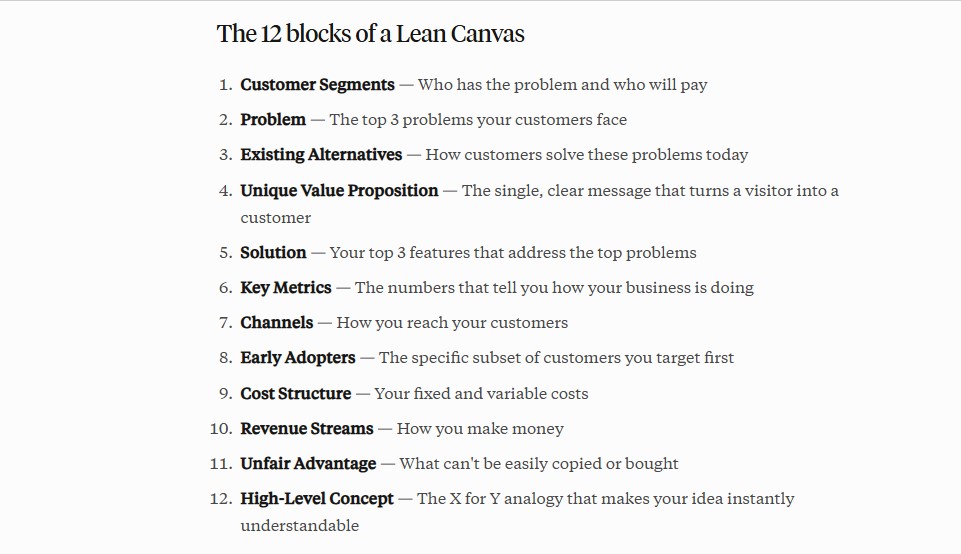
Image source: leanspark.ai
One of the useful artifacts for PSF-stage thinking is the Lean Canvas, developed by Ash Maurya as an adaptation of Alexander Osterwalder’s Business Model Canvas. It functions as a structured way of surfacing your assumptions before you test them.
The most relevant sections of the canvas at the PSF stage are:
- The Problem box (the top 3 problems you’re solving for your customer segment),
- The Existing Alternatives box (how your target customer currently manages the problem),
- And the Unique Value Proposition box (why your solution is better than the current workaround).
The Problem and Existing Alternatives boxes force the founder to ask if people have this problem badly enough to pay to solve it, why haven’t they already?
If the existing alternatives are inadequate, then that’s an argument for your solution. But if they work reasonably well, you need to do a harder job to make your PSF case.
The Value Proposition Canvas, developed by Osterwalder, is a tool for mapping customer jobs, pains, and gains against your proposed product features and benefits. It is a useful framework for customer interviews, conversations, and interpretation.
The most important thing about any PSF canvas is that it’s a living document, and you’d need to keep iterating. The value of maintaining it is that every round of customer interviews gives you a chance to replace assumptions with evidence.
When to Move From Problem-Solution Fit to Product-Market Fit
1. Consistent problem confirmation
You’ve spoken to 15 to 20 people in your actual target segment who have no prior relationship with you, and they consistently confirm the same problem with the same emotional intensity. This has to come from people outside your immediate network. Otherwise, you’re just validating your own assumptions.
2. At least one form of paid or committed validation
A letter of intent from a B2B prospect, a deposit on a waitlist, or a pre-order for a B2C product; any form of financial commitment, however small, from someone who isn’t a friend or family member. When someone puts money behind a problem, they’re confirming that the pain is real enough to act on, which is a qualitatively different signal from conversation alone.
3. A clearly scoped solution that early adopters are actively waiting for
This means you can describe specifically, not aspirationally, what you’re going to build first, and a cohort of validated early adopters has said, explicitly, that they’ll use it.
The Question Founders Should Be Able to Answer Before Writing a Line of Code
Every section in this article builds toward answering the question below:
Do enough people have this problem badly enough that they’d pay to have it solved, even in an imperfect form?
If your answer is a confirmed, evidence-backed yes, supported by consistent problem confirmation, at least one form of financial commitment, and a specific scope of solution that early adopters are waiting for, then you’ve earned the right to build toward Product-Market Fit.
But if your answer is “I think so,” “my interviews went well,” or ” the investors seemed interested,” you haven’t yet and it’s best to pause until you’re able to answer the question.
At SMELighthouse, we’ve had to end engagements because the validation data was telling us something the founder didn’t want to hear, and we thought it was more important to say it than to take the money. We’ve been thanked for those conversations, sometimes months later, by founders who went back to the drawing board and came back with something stronger.
If you’re struggling with the above question, book a free 30-minute discovery call with our team of consultants. We’ll work through what you have together, tell you honestly what it means, and help you decide what to do next.
Common Questions Founders Ask Us
Q: What is Problem-Solution Fit?
Problem-Solution Fit is the validation stage at which a founder has confirmed that a specific, painful problem genuinely exists for a defined group of people and that the proposed solution would address that problem in a way those people would pay for, even in an unfinished form. It’s a pre-build milestone and the foundation for Product-Market Fit.
Q: What’s the difference between Problem-Solution Fit and Product-Market Fit?
Problem-Solution Fit validates the problem and the solution concept, primarily through qualitative evidence like customer interviews and pre-orders, before or during early MVP development. Product-Market Fit validates that a built product retains and grows a paying mainstream market at scale, evidenced by retention data, organic growth, and revenue patterns. PSF comes before PMF, and it’s impossible to achieve PMF without first confirming PSF.
Q: How do I validate Problem-Solution Fit?
Validation involves defining a precise problem hypothesis, conducting 15 to 20 customer discovery interviews with your actual target segment, testing the solution concept through a prototype or landing page, and looking for 3 specific signals: unprompted problem articulation, willingness to commit financially before the product exists, and active workaround behaviour that confirms the problem is painful enough to act on.
Q: How do I know when I’ve achieved Problem-Solution Fit?
PSF is confirmed when you have consistent problem validation across diverse interviews, at least one form of paid or committed validation from a non-affiliated prospect, and a clearly scoped solution that a cohort of early adopters is actively waiting to use. Steve Blank suggests a minimum of 3 to 5 genuinely satisfied paying early adopters as a baseline.
Q: Can I achieve Product-Market Fit without Problem-Solution Fit?
No. PMF requires sustained retention and organic growth from a mainstream market. And without confirmed evidence that the problem is real and the solution direction is credible, there’s nothing to build toward PMF on.
Related Reading:

Onyekachukwu Blessing
http://linkedin.com/in/onyekachukwu-blessingOnyekachukwu Blessing is an SEO content strategist specializing in organic growth, editorial strategy, and long-form content. She creates research-driven content that helps businesses improve search visibility, build topical authority, and communicate complex ideas with clarity. Her work spans startups, SaaS, business, and digital publishing.