The $465B Paradox: Why 90% of Startups Still Fail Despite Record SaaS Funding
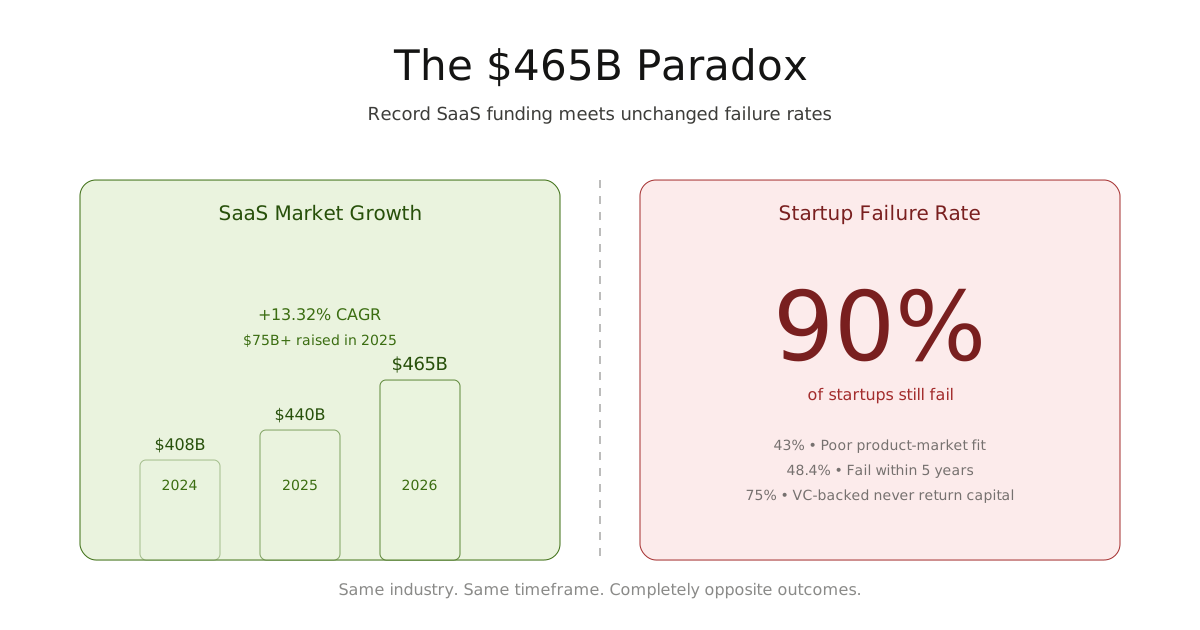
Despite the global SaaS market projection reaching $465.03 billion in 2026, up 13.32% from 2025, approximately 90% of startups still fail. Of those failures, 43% shut down because there is simply no market need for what they built.
The paradox is structural in nature. Capital availability has recovered, but founder discipline has not. While B2B SaaS companies raised over $75 billion in 2025 alone, only 40% of startups conduct formal market validation before they launch anything. However, access to funding does not equal validation of ideas.
Series A rounds for AI-native SaaS now average $22 million compared to $15 million for traditional SaaS. And yet, 48.4% of startups still fail within five years. More capital is flowing than ever before, but it is being destroyed faster because founders consistently confuse access to capital with proof of market need.
Common Questions About Startup Failure Rates
What percentage of SaaS startups fail?
Recent industry data shows that approximately 92% of SaaS startups fail within their first three years. While general business failure rates hover around 20% to 21.5% in their first year, software-as-a-service companies face an accelerated survival cliff, with 48.4% failing within five years total. Despite record-breaking venture capital and SaaS funding rounds, the vast majority of software founders still struggle to achieve sustainable market fit.
What is the main reason startups fail even after raising capital?
Data indicates that 43% of startups fail due to a lack of product-market fit, meaning they build products that do not meet market demand. While running out of cash accounts for 70% of failures, it often results from not validating the product early on.
How much funding did the SaaS industry raise in 2025 and 2026?
The global SaaS market is projected to reach $465.03 billion in 2026, up from $408.21 billion in 2025 according to Hostinger’s SaaS statistics report. B2B SaaS companies alone raised over $75 billion in 2025 per Growth List’s database. Despite this record capital deployment, startup failure rates remain unchanged at approximately 90%.
What percentage of startups fail in their first year?
Approximately 20 to 21.5% of startups fail within their first year, according to the U.S. Bureau of Labor Statistics as reported by Investopedia. The failure rate accelerates between years one and five, with 48.4% failing within five years total. First-time founders have only an 18% success rate, though founders with prior startup experience see that number rise slightly to 20%.
Do venture-backed startups have better survival rates?
No. Surprisingly, 75% of venture-backed startups fail to return capital to investors according to Harvard Business School research. Access to funding does not guarantee success without proper market validation and disciplined execution. Before choosing a funding path, founders should understand the operational realities of running a bootstrapped SaaS vs. VC-backed company in 2026.
Why 90% of Startups Fail Despite Record Funding
The numbers tell two completely different stories, and both are true.
On one side, the global SaaS market is projected to reach $465.03 billion in 2026 while growing at a compound annual growth rate of 13.32% through 2034. B2B SaaS companies secured over $75 billion in venture capital in 2025, representing the highest level since the 2021 peak. North America’s SaaS market alone will hit $211.7 billion by the end of 2026, holding 46% of global market share. Software spending is forecast to grow 15.2% year-over-year according to Gartner, making it the fastest-growing IT spending category.
On the other hand, approximately 90% of startups still fail. Of those, 43% shut down because of poor product-market fit. Another 48.4% fail within five years. And perhaps most striking, 75% of venture-backed startups never return cash to investors.
Same industry; same timeframe; completely opposite outcomes.
The question then is not whether SaaS is growing. It is, why is capital abundance not reducing failure rates?
The answer lies in the discipline gap.
In earlier startup eras, limited capital forced founders to validate ruthlessly. Teams had little margin for extended experimentation, which meant assumptions about customer problems and demand were often tested before significant product development began.
But when $75 billion is flowing into the SaaS market and Series A rounds average $22 million for AI startups, things change. The cost of skipping validation has dropped below the psychological threshold where founders take it seriously.
In 2015, raising a seed round required proof: customer conversations, revenue evidence, or, at minimum, validated problem-solution fit. Today, in 2026, a founder can raise $2 to $3 million on a pitch deck and a prototype. The time from idea to funded has compressed from 18 months to 6 months, and in that compression, validation often gets skipped. CB Insights data shows that 43% of startups fail because of poor product-market fit.
Faster access to capital creates faster paths to failure. Pre-seed rounds now range from $500,000 to $2 million, up from $250,000 to $500,000 in 2018. Seed rounds average $3 to $5 million, up from $1 to $2 million. Yet the median time to first pivot remains at 17 months, usually just before cash runs out. A founder raises $3 million seed on vision alone, spends 12 months building, launches to crickets, and realizes market need does not exist. They burn through runway trying to pivot while burning 24 months.
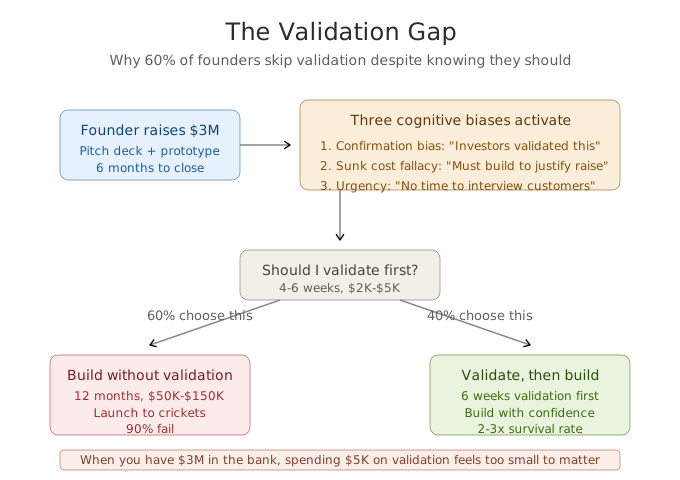
Only 40% of startups conduct formal market validation before launch. That means 60% skip it entirely and of those, 90% fail. The cost of validation is $2,000 to $5,000 and takes 4 to 6 weeks, while the cost of building the wrong thing is $50,000 to $150,000 and takes 12 to 18 months. Validation represents just 5 to 10% of total capital outlay. Therefore, if spending $5,000 and 6 weeks could tell you whether your $100,000 idea will work, why would you skip it?
In 2026, the average time from incorporation to Series A is 18 to 24 months for AI startups, down from 36 to 48 months for traditional SaaS. That sounds like progress, but the compression hides the fact that raising larger rounds earlier creates psychological permission to delay validation.
When you have 12 to 18 months of runway and a $3 million seed round, the pressure to validate before you build disappears. You can afford to build first and ask questions later. And that is exactly what 60% of founders do. By the time they discover there is no market need, usually 12 to 15 months in, 70 to 80% of their capital is gone and the result is a predictable race to pivot or fail and most fail trying.
Why Building Faster Is Not the Solution
AI tools like Cursor, GitHub Copilot, and Claude Code have made building 60 to 70% faster and cheaper. McKinsey’s 2025 research shows 28% of organizations now use generative AI in product development, with development cycle times down 70% with AI tools when these tools are integrated into the workflow.
At first glance, that sounds like pure progress. Teams can prototype faster, ship faster, and iterate faster than at any point in the history of software.
But speed does not fix bad decisions. Research shows that 95% of generative AI pilot projects fail to deliver meaningful ROI, while 43% of startups still fail because of poor product-market fit.
In other words, faster building without validation simply means building the wrong thing faster.
The real bottleneck in modern startups is no longer engineering. It is decision quality. And when capital is abundant, the cost of making the wrong decision feels lower, which makes it easier for founders to move forward without the discipline of validation.
The Structural Problem: Why Founders Skip Validation Even When They Know Better
Every founder knows they should validate. So why do they not do it? The answer is incentive misalignment and cognitive bias.
When a founder raises $3 million on a pitch deck, three things often happen psychologically:
- Confirmation bias activates: The founder thinks investors validated the idea by funding it, which they did not. They validated your ability to pitch.
- Sunk cost fallacy takes over: The founder has already spent 6 months pitching and feels they need to start building to justify the raise.
- Urgency replaces rigor: The founder has 18 months of runway and needs to show traction, so they feel they do not have time to interview customers.
The irony of it all is that the market rewards founders for raising capital, not for validating ideas. TechCrunch writes about your fundraise. LinkedIn celebrates your round. Your investors expect progress, defined as features shipped. And nobody asks whether you validated that anyone wants this until 12 months later when revenue is not growing. And by then, it is too late.
Why Founders Confuse Fundraising Ability with Market Readiness
The key misconception works like this: if investors gave me $3 million, then the market must need this, which is different from reality.
Investors bet on team quality, market size, vision, and timing along with trends, especially AI in 2026. They do not bet on validated customer needs at the seed stage.
According to Growth List’s 2026 research, investors are pattern-matching rather than validating. They ask whether this could become a $1 billion company, not whether there is proven demand for this specific product.
What Founders Should Do Differently in 2026
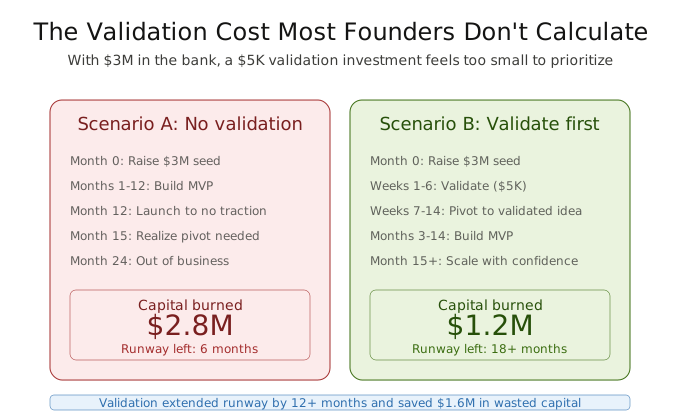
At SMELighthouse, we have turned down projects because our validation process revealed the ideas that would not work. We have killed founder ideas in week two of discovery and have been thanked for it because the alternative was spending $500,000 and 18 months building something nobody wanted.
The market will not fix the 90% failure rate. Investors will not fix it. The only people who can are founders themselves by treating validation as non-negotiable.
- If you have not raised yet: Validate before you pitch and include validation data in your deck. Validate before you pitch and include validation data in your deck. Learn the exact framework in our comprehensive guide: How to validate a SaaS idea
- If you have already raised: Pause building for 4 to 6 weeks to validate. Accept that pivoting now is cheaper than failing later.
- If you are using AI tools to build faster: Use AI to accelerate validated ideas, not untested ones. Protect your budget by reading our strategy on lean SaaS MVP development.
If you’re not sure about your idea, book a free 30-minute discovery call. We will tell you honestly whether you should build, pivot, or kill the idea.
Your Validation Questions Answered
How long does proper startup validation take?
4 to 6 weeks, costing $2,000 to $5,000 DIY, or $5,000 to $15,000 with a consultancy like ours. This includes 15 to 20 customer interviews, solution testing with prototypes, and willingness-to-pay validation through pre-orders or letters of intent.
What is the difference between validation and market research?
Market research is passive data collection through surveys, reports, and total addressable market analysis. Validation is active hypothesis testing with real potential customers. Validation asks whether someone will buy this specific solution, while market research asks whether people generally care about this topic area.
Can I validate a SaaS idea without building anything?
Yes. Use low-fidelity mockups, landing pages, and customer interviews to test problem-solution fit.
How many customer interviews should I do before building?
Minimum 15 to 20 interviews. When 70% or more validate the same problem and solution, you have a signal worth acting on.
What if validation shows my idea will not work?
This is actually the best possible outcome even though it does not feel like it. You save $50,000 to $150,000 and 12 to 18 months; use the insights from validation to pivot to an idea that will work; or return investor capital before you waste it.
Is it too late to validate if I have already started building?
No. Pause for 4 to 6 weeks and validate core hypotheses. Better to delay launch than build for 12 months and find no market need.
What is the success rate for startups that validate properly?
Startups that validate properly have 2 to 3 times higher survival rates than those that skip validation.

Onyekachukwu Blessing
http://linkedin.com/in/onyekachukwu-blessingOnyekachukwu Blessing is an SEO content strategist specializing in long-form content, editorial strategy, and organic growth. She creates research-driven content that helps businesses improve search visibility, build topical authority, and communicate complex ideas clearly. Her experience spans business, lifestyle, startups, wellness, SaaS, and digital publishing.